Why a Practice Goal Needs a Visible Action
A visible-action practice goal gives a drill a clear focus, helps athlete and coach review what happened, and keeps feedback tied to something they can see.
What should you do when a practice goal feels too vague to guide the next repetition? Turn it into a visible action. A visible-action practice goal gives the athlete something specific to try and the coach something concrete to observe.
“Improve my passing” names a hope, not a task. “After receiving the ball, turn towards the open side before passing” points attention towards an action. The pass may still miss; the goal describes what to attempt, not a promised result.
Vague goal wording
“Get sharper” could mean quicker footwork, cleaner timing or more decisive choices. An athlete may focus on one interpretation while a coach watches for another, leaving both unsure what to assess.
Ask, “What would I see if this were happening?” Choose one action that fits the drill: a starting position, movement, cue or decision. Keep the wording clear enough to recognise while practice is under way.
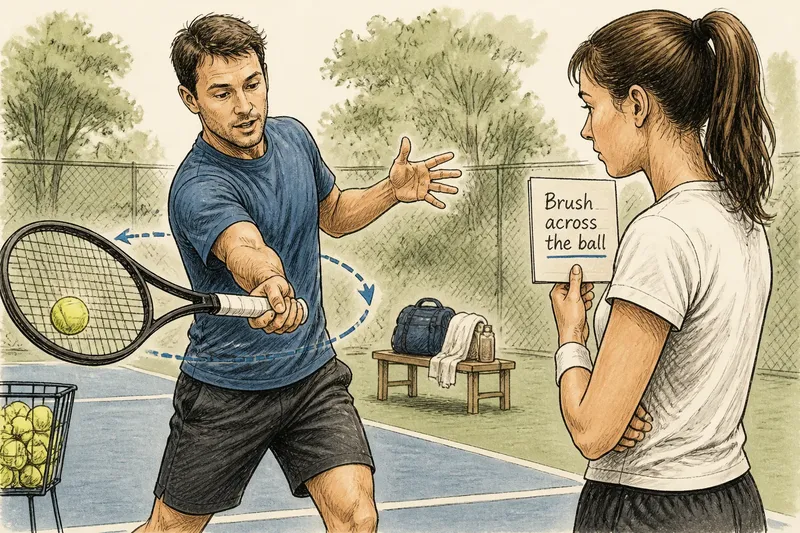
In a tennis feeding drill, “be more consistent” offers little direction. “Recover towards the centre after each shot” names an observable action. The rally can still break down, but athlete and coach can discuss whether the recovery movement happened and what was going on around it.
One action at a time
Some goals bundle several demands: move quickly, stay relaxed, make the right choice and finish cleanly. That may sound thorough, but it gives the athlete several things to monitor at once. Feedback can then become muddled: which action needs attention first?
Select the session’s main focus and let other coaching points remain separate. For a basketball lay-up, a goal might be to take off from the appropriate foot after the final approach step. The coach can still offer other feedback, but the goal itself stays legible.
Say a swimmer is practising a calmer turn, and the coach also wants to address breathing. The goal could be “finish the final stroke before beginning the turn”. The breathing cue can remain a separate prompt; combining both actions would make it less clear which one is the focus.
Visible actions and private states
“Commit to the decision” or “stay confident” may express a useful intention, but neither has a clear outward sign by itself. A coach cannot directly observe confidence. They can observe whether an athlete calls for the ball, begins a movement or follows a planned option.
Translate the intention into an action without claiming the action proves how the athlete feels. For example, replace “be confident receiving the serve” with “set the racket in front before the serve arrives”. The second phrase gives the athlete something concrete to practise; it does not measure confidence.
An observable action is evidence of a behaviour, not a verdict on motivation or readiness. If hesitation might come from uncertainty about the drill, ask what is unclear rather than treating a missed action as a personal failing.
Actions and outcomes
Goals framed only as outcomes can be difficult to use during a practice repetition. “Win the rally” depends on an opponent’s response as well as the athlete’s choices. “Serve an ace” likewise names a result the athlete cannot control alone. Outcomes may matter in competition, but they are blunt instructions for practice.
Separate the result from the action that can be rehearsed. A volleyball player might replace “win the point with my serve” with “begin the serving motion from a balanced stance”. The stance is the practice action; where the ball lands and who wins the point remain outcomes.
Outcome language still has a place. If a session is about making a tactical choice under pressure, name the choice to make when the situation appears. Review both the decision and the result without treating either as proof of the other.
Review without verdicts
A visible goal can make review more useful, but it can also tempt a coach to label a repetition “done” or “failed”. An action may be hard to see in a busy drill, happen quickly or change as the athlete adapts. A rigid verdict can obscure what the athlete was trying to do.
Before practice, agree on what the action looks like and when it should happen. After a short set, ask what the athlete noticed, then share the coach’s observation. If the wording still allows different interpretations, refine it before continuing. Review should help shape the next practice focus, not certify a fixed ability.
Try asking, “What did you do just before that result?” The question invites a description of the sequence instead of a quick label such as “good” or “bad”. If the action happened but the outcome did not, discuss an adjustment; if it did not happen, look for a cue or drill condition that could make it easier to recognise and practise.
Choosing a practice goal?
How do I make a goal observable?
Name a movement, decision, position or cue another person could see during the drill. Add when it should happen, such as “after the pass” or “before the landing”.
Can a practice goal include a result?
Yes, particularly when the session concerns tactics or competition demands. Pair the result with an action the athlete can attempt, so the practice still has a clear focus.
What if the action is hard to notice?
Simplify the wording or adjust the drill so the action has a clearer moment to appear. Athlete and coach can also agree to watch for it during a specific part of practice.
What should I change after a missed action?
First check whether the athlete understood the cue and whether the drill gave the action a fair chance to appear. If either is unclear, adjust the wording or drill before deciding what to practise next.
Wording that works
A workable practice goal is brief enough to remember and specific enough to observe. It identifies an action, places it in a relevant moment and leaves room for an imperfect attempt. Read the sentence aloud and ask whether athlete and coach would recognise the same behaviour.
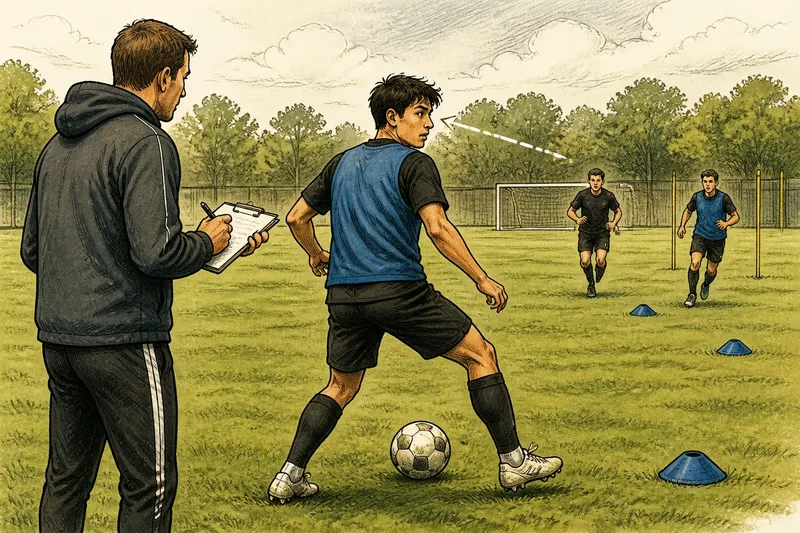
For a final check, consider a hypothetical football drill in which a player receives a pass with their back to goal. The starting goal is “make better decisions”, which gives no shared sign to watch. The coach and player revise it to “check over one shoulder before the ball arrives”; during the drill, they observe whether that scan happens, then decide whether to keep the cue or clarify it. The trade-off is deliberate: the goal focuses on the scan, not on whether the next pass succeeds.
A visible-action practice goal directs attention and gives review something concrete to discuss. Its useful next question is just as specific: after observing the action, what cue or adjustment would make the next repetition clearer?