Demonstration or Written Cue: Choosing a Prompt for Movement Learning
Compare movement demonstrations with written cues to choose a prompt that helps learners notice a useful detail and make sense of their next attempt.
Should you watch the movement or read a cue before trying it? For movement learning, a demonstration shows how an action looks, while a written cue directs attention to a particular detail. The better prompt depends on what the learner needs to notice before the next attempt.
What each prompt offers
A demonstration makes relationships visible: how the trunk turns as the arm travels, when a foot leaves the floor, or how one part of a sequence leads into another. It presents the movement as a whole, so the learner still needs a reason to look closely.
A written cue narrows the focus. “Keep your eyes on the target” draws attention somewhere different from “let your throwing arm follow through”. A short phrase on a card can be easy to revisit between attempts, but it cannot show timing or appearance on its own.
These prompts do different jobs. A demonstration gives the learner a visible model to interpret; a cue names one feature to attend to while moving.
When demonstrations help
Use a demonstration when a movement’s shape or sequence is hard to picture from words alone. A coach showing a badminton serve can make the relationship between preparation, contact and follow-through visible. The learner might first watch the whole action, then view it again with one feature in mind.
Give each viewing a clear focus. “Watch the whole serve” may leave a beginner unsure what to remember. “Notice where the racket is at contact” gives the learner a specific detail to look for. A slower demonstration or a still position can clarify that detail, as long as the learner knows a still image shows only one moment of a moving skill.
Watching is not the same as performing. A polished model can look simple because the performer already knows the movement. Invite the learner to try the skill after watching, then ask what stood out instead of replaying the demonstration without a fresh purpose.
When written cues help
A short written cue can help when the learner understands the general movement but needs a reminder about one feature. Before a basketball free throw, “finish with your fingers towards the hoop” may be easier to use than a long explanation of the entire action.
Choose words that name an observable action. “Be more athletic” gives little direction; “land softly” describes something the learner can try to notice. Its usefulness still depends on the task and the learner’s understanding. Avoid stacking instructions: if the learner is trying to remember several phrases, simplify the focus before adding another.
A note beside a practice area can stay visible between attempts. The learner can glance at “quiet feet on landing”, perform, and then decide whether that phrase helped them notice a useful feature. If it did not, revise the wording rather than treating the note as a rule.
Choose the next prompt
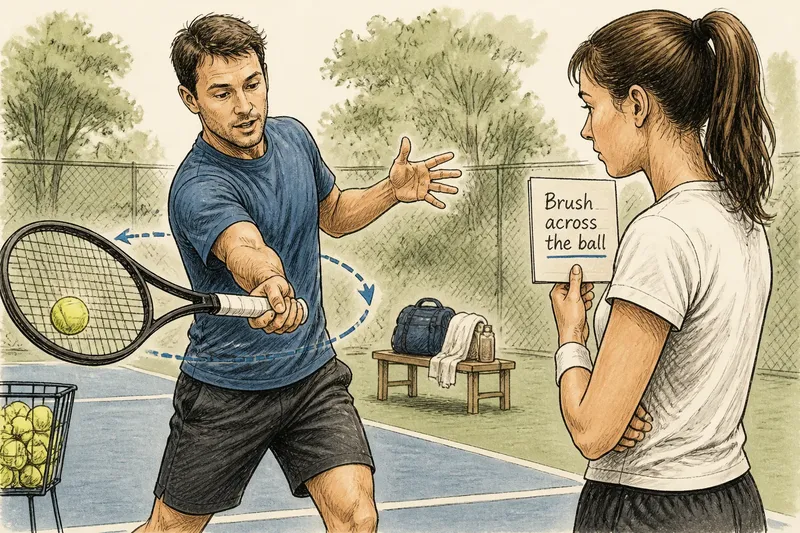
Imagine a beginner learning a tennis forehand who cannot tell how the racket travels from preparation to contact. The coach first demonstrates the swing slowly and asks the learner to watch the racket path. The learner describes that path, then tries the swing with the cue “brush across the ball”. The observable outcome to look for is whether the learner can describe the intended path and say what they focused on during the attempt; a changed technique is not assured.
Here, the demonstration supplies a picture and the cue directs attention to a feature within it. The pairing is useful only if each prompt has a clear purpose. If the learner already knows what to attend to, another demonstration may add little; if the movement is unfamiliar, a phrase may not create a clear picture.
- Check whether the learner can describe the movement’s sequence; if not, show a demonstration, then ask them to describe one visible part, or simplify the movement description.
- Check whether the learner can point to the feature that needs attention; if they can, write a brief cue naming it, or ask them to watch a demonstration for that feature.
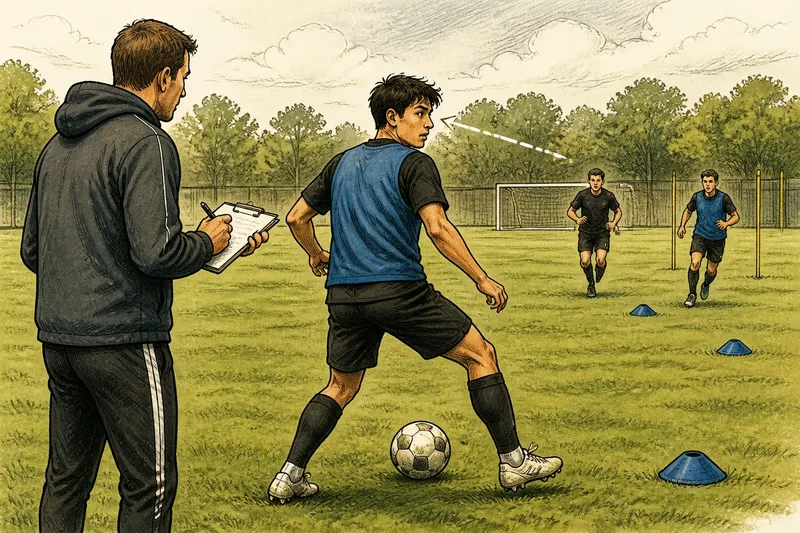
- Check whether the learner looks at the intended part of the model; if not, give one specific viewing focus, or show the action from a clearer angle.
- Check whether the cue names an observable action; if it does, leave it visible for the next attempt, or replace vague wording with a concrete action.
- Check whether the learner can remember the cue while moving; if not, shorten it or return to a demonstration that shows the feature.
- Check whether the learner can explain what they noticed after trying; if they can, keep the prompt for the next attempt, or change it if their answer shows it drew attention elsewhere.
Questions about movement cues?
Should a learner watch a demonstration more than once?
Repeat a demonstration when the next viewing has a clear purpose, such as noticing the whole sequence first and a particular position afterwards. If another viewing offers no new focus, invite the learner to try the movement and describe what they noticed.
How long should a written cue be?
Keep it brief enough to recall during the task and clear enough for that learner to act on. If it takes several clauses to explain, simplify the wording or show the movement instead.
Can a coach combine a cue and a demonstration?
Yes: the demonstration can show the movement, while the cue names one feature to watch or try. Show the action, state the focus, then give the learner room to attempt it without a running commentary.
What if the learner copies the wrong detail?
Ask what they watched, then give them a different, specific focus. A clearer angle or a simpler demonstration may help them identify the intended feature without implying that every visible detail should be copied.
Use the learner’s response
After an attempt, ask whether the prompt helped the learner attend to the intended feature. They might describe what they saw, point to what felt unclear, or name the cue they tried to use. That response gives you a concrete reason to keep or change the prompt.
If the learner can describe the idea but cannot yet coordinate the movement, simplify what you ask them to notice: use a slower model, a simpler version of the skill, or one clear cue. If they can perform while using the cue but no longer find it useful, change it. For movement learning, the best prompt is the one that makes the next attempt easier for the learner to understand.